


When Desire Feels Mismatched
(And You Start Questioning Yourself)

It’s late.
The house is finally quiet.
You’ve been moving all day — work, messages, responsibilities, maybe children, maybe just the mental load that never quite switches off.
You sit down next to your partner.
And you can feel it.
That subtle moment where something might happen.
An arm around your shoulder.
A kiss that lingers a little longer than usual.
And instead of warmth…
you feel pressure.
Because your body already knows where this might be heading.
In my clinical experience, mismatched desire is the most common sexual challenge people experience in relationships.
“We still love each other.
We respect each other.
We are committed to the life we are building together.
But somewhere along the way, desire has faded.”
There has been no dramatic rupture.
No betrayal.
No obvious crisis.
Just the slow, almost invisible shift from lovers to partners managing life together.
Mismatched Desire Is a Relational Problem
One of the first things I want you to understand is this:
MISMATCHED DESIRE IS A RELATIONAL PROBLEM
It simply means there is a difference between how often and how much two people want to have sex. It is not a one-person problem.
Because if one of you were with someone who wanted sex at the same frequency and level, there would be no problem.
That’s why mismatched desire is a relational issue. It lives between two people.
And once we begin to see it this way, something important shifts —
We stop asking: “Who is the problem?”
And start asking: “What is happening between us?”
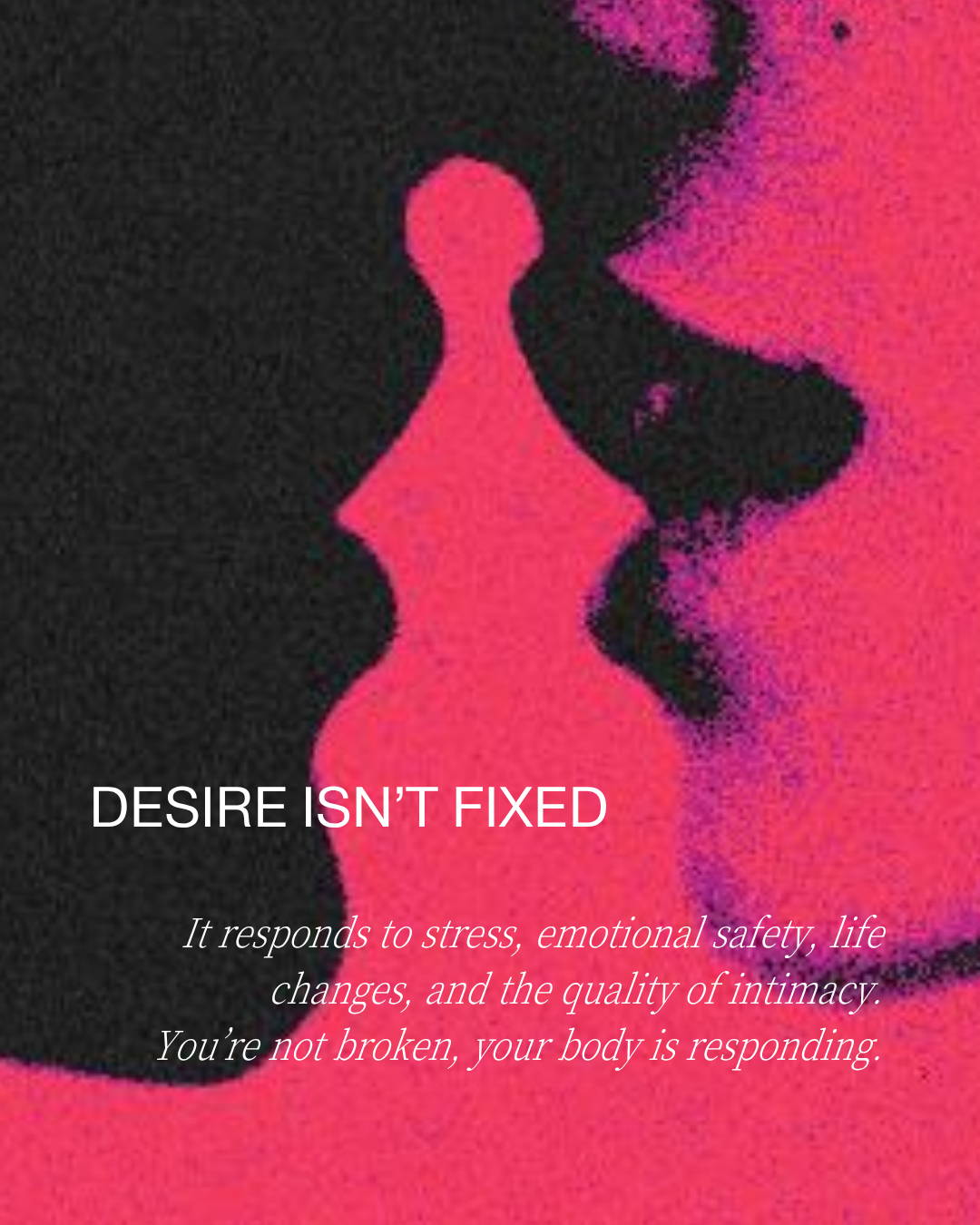
DESIRE RESPONDS TO ENVIRONMENT
To answer that question, we need to understand how desire actually works.
Desire is not a tap you turn on and off.
It’s not something you either “have” or “don’t have.”
Desire emerges in an environment — physical, emotional, and relational.
And when that environment changes, desire changes.
So most of the time, when desire changes, it is not dysfunction.
It is responsiveness.
Which means that as life changes, desire will change too.
Most long-term relationships move through seasons:
Parenthood. Pregnancy. Menopause. Illness. Work pressure. Ageing parents. Mental load.
These aren’t interruptions to intimacy — they are the context of your intimate and erotic life.
And your body responds to that context, whether you’re consciously aware of it or not.
The Two Most Harmful Messages About Low Desire
When desire changes, many people are given two very harmful explanations.
The first is:
“You’re doing something wrong.”
So you’re given more tools. More techniques. More advice.
How to touch better.
How to be more exciting.
How to turn each other on.

A Distinction That Changes Everything
Here is another very helpful and important distinction.
There is a difference between:
“I don’t desire sex.”
And:
“I don’t desire this sex.”
“This sex” might be:
• Rushed sex
• Predictable sex
• Emotionally disconnected sex
• Sex that is based on obligation
• Sex that is centred on one partner’s needs
• Sex without attunement
In these moments, desire hasn’t disappeared.
It has gone quiet in response to the quality of your erotic experience.
WHY YOU'RE "NEVER IN THE MOOD" (AND WHAT TO DO INSTEAD"
Many people come to me and say:
“I’m never in the mood anymore.”
But when we unpack it, what they often mean is:
“I don’t get those sudden waves of arousal.”
Or
“I don’t feel like initiating sex.”
And they assume desire has disappeared.
But most often, something else is happening.
We’ve been taught to expect spontaneous desire — the kind that appears out of nowhere.
But in many long-term relationships, desire works differently.
It doesn’t come before connection.
It comes after.
After closeness.
After touch.
After emotional safety.
You start with openness, presence, and emotional connection.
And your body begins to respond.
Desire follows — not because you forced it, but because the conditions were right.
WHERE COUPLES GET STUCK
This is where many couples unknowingly get stuck.
They think:
“I’ll initiate when I’m in the mood.”
But if your desire is mostly responsive, that moment may never arrive.
Not because you don’t want intimacy.
But because your body needs connection first.
So both partners wait.
And nothing happens.
This Is Not About Forcing Yourself
I want to clarify something here.
Responsive desire does not mean forcing yourself.
It does not mean overriding your boundaries.
It does not mean “just doing it anyway.”
It means saying:
“I don’t feel desire right now…
but I’m open to connecting.”
“I’m curious about what might emerge.”
That is very different from obligation.
For responsive desire to truly work, there needs to be truly no pressure.
The goal is not a specific outcome.
The goal is connection.
It might look like:
A long kiss.
A shoulder rub.
Cuddling.
Slow, attentive touch.
With no expectation.
No destination.
When the body knows:
“I’m safe.”
“I’m not being evaluated.”
“I’m not being pushed.”
It relaxes.
And often, desire follows.
WHAT IF NOTHING IS BROKEN?
This brings us to perhaps the most important reframe of all.
One of the most damaging patterns is searching for the “problem partner.”
The one with low libido.
The one who wants too much.
The one who needs fixing.
But desire doesn’t live inside one person.
It lives between you.
So the work isn’t forcing desire back.
It’s getting curious about:
• What kind of intimacy feels good now
• What version of sex feels alive
• What helps each of you feel safe and open
Because sometimes, desire hasn’t disappeared.
The old script has.

And something new is waiting to be written.
Anisa Versah is a qualified sexologist and relationship educator at Relate Sexology, dedicated to helping individuals and couples build deeper, more confident connections with themselves and others. With a passion for breaking down stigma and making conversations around intimacy more accessible, Anisa brings a warm, inclusive, and evidence-based approach to her work.
Her expertise spans sexual wellness, communication, desire, and modern relationship dynamics, with a particular focus on helping people navigate real-life challenges with clarity and compassion. Anisa is known for translating complex topics into practical, relatable insights that empower people to feel more informed, confident, and in control of their sexual wellbeing.
As a contributor to Dripfeed, Anisa shares thoughtful, engaging content designed to spark conversation and support readers in exploring their own experiences. Her writing blends professional knowledge with a down-to-earth tone, covering everything from desire and pleasure to communication and self-awareness.